Local Clubsin Northcote
The Night the Ceiling Cracked
5 Nov 2026
By Christian Gravias
Australian football once had packed derbies, famous players and some of the most passionate supporters in the country. Then it began losing the very culture that made it special. South Melbourne's historic Australia Cup triumph was more than a sporting upset. It was a reminder of what Australian football could be again.
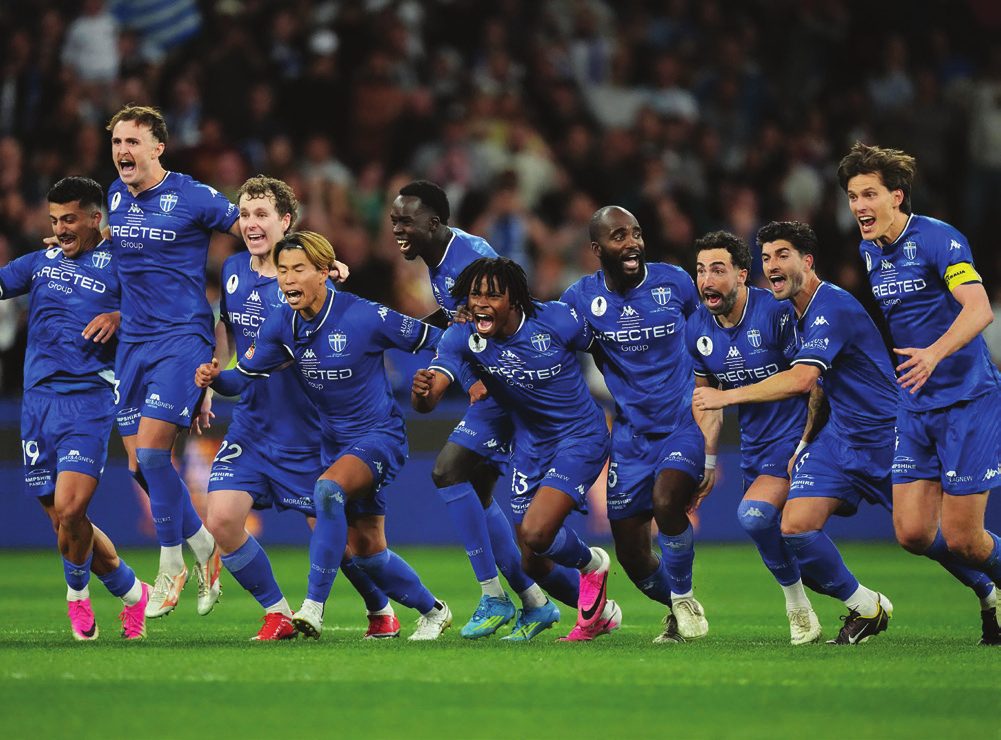
For one night, Australian football felt alive again. Almost 30,000 supporters packed AAMI Park on 10 October to watch South Melbourne take on Melbourne Victory in the Australia Cup final. There was colour. There was noise. There were generations of supporters singing for a club that meant something deeply personal to them. And when South Melbourne defeated their A-League opponents on penalties, completing one of the greatest upsets in Australian domestic football, it felt like something much bigger than a trophy had been won.
From the stands, it appeared South Melbourne had brought more supporters than Victory. And judging by the noise, their supporters certainly made the stronger impression. The singing, the flags, the emotion and the celebrations created an electric atmosphere. It felt authentic. It felt like football. And it reminded us of something Australian football has spent the better part of a decade losing.
Remember when the A-League was exciting?
There was a time, not that long ago, when the A-League genuinely felt like it was becoming something special. Melbourne Victory had established one of the country's most passionate supporter bases. Sydney FC's Cove was creating an atmosphere that helped define the club. Then Western Sydney Wanderers entered the competition, and the Red and Black Bloc (RBB) took active support to another level.
The Sydney derbies became enormous occasions. Melbourne derbies carried genuine tension, anticipation and rivalry. Supporters marched to stadiums, sang throughout matches and created the kind of spectacle that made people who weren't necessarily football fans stop and pay attention. And the numbers reflected that excitement.
In October 2016, more than 61,000 people attended the Sydney derby between Western Sydney Wanderers and Sydney FC. Think about that. Australian domestic football was attracting crowds of more than 60,000 to regular-season matches. The competition had star power, too.
Alessandro Del Piero arrived at Sydney FC. Dwight Yorke had helped launch the league. Shinji Ono became a cult hero at Western Sydney. Besart Berisha was a household name among football supporters. And in 2016, Tim Cahill returned to Australia to play for Melbourne City. One of the greatest Socceroos of all time was playing in our domestic competition. His extraordinary long-range goal against Melbourne Victory was precisely the kind of moment that captured attention beyond football's traditional audience.
The game had momentum. It had personalities. It had stories. But most importantly, it had supporters who were passionately invested in their clubs. Those supporters weren't simply attending the spectacle. They were creating it.
The supporters were building the game
There's something unique about football culture that Australians who haven't experienced it firsthand may struggle to understand. You can attend an AFL match at the MCG with 80,000 spectators and experience an extraordinary occasion. But you can also attend a football match with 20,000 supporters and feel an atmosphere every bit as intense, sometimes even more so. It's not about which sport is better. It's about the culture.
Football supporters sing for ninety minutes. They create chants that become part of their club's identity. They organise themselves, travel together and build traditions that can last generations. A supporter group becomes more than a collection of people sitting in the same section of a stadium. It becomes a community. And the relationship between supporters, clubs and players creates something that cannot simply be purchased.
When a player scores and runs towards the active supporters, when an entire terrace erupts into song, or when thousands stand together after a heartbreaking defeat, that's what makes football extraordinary. The A-League was beginning to capture that feeling. The RBB, Melbourne Victory's North Terrace and Sydney FC's Cove weren't obstacles to the game's growth. They were among the reasons the game was growing. And then the relationship began to break down.
When Australian football turned on its own supporters
In 2015, Australian football found itself at the centre of a bitter debate about supporter behaviour, stadium security and the treatment of active fans. Mainstream media coverage increasingly focused on incidents involving football supporters. The publication of a leaked list identifying 198 banned A-League supporters became a flashpoint.
There were legitimate concerns about unacceptable behaviour, and no sport should tolerate violence or threats to public safety. But there was another side to the story. Supporters complained about heavy-handed policing, intrusive security practices and bans issued without adequate transparency or a meaningful avenue of appeal. Many felt they were being treated as potential troublemakers simply because they were passionate football supporters.
And when some media commentators portrayed football crowds in deeply negative terms, many fans believed Football Federation Australia had failed to stand up for them. In my view, this was one of the great mistakes Australian football made. Rather than defending the overwhelming majority of supporters who were helping build the competition, the game's administrators appeared more concerned with responding to negative headlines.
The supporters who gave the A-League much of its colour and identity increasingly felt abandoned. Active supporter groups organised boycotts. The atmosphere that had helped make the competition so distinctive began to suffer. FFA eventually agreed to changes to its supporter-banning processes, but substantial damage had already been done to the relationship.
The game needed to deal firmly with genuine misconduct. But it also needed to recognise the difference between dangerous behaviour and passionate football culture. You cannot build a football competition around its supporters and then treat those same supporters as a problem to be managed. Football needs its fans. Not just as paying customers. As partners in the identity and success of the game.
Expansion without the connection
While the relationship with active supporters was deteriorating, Australian football was also making decisions about the future of its professional competition. The A-League continued expanding, introducing clubs such as Western United and Macarthur FC. Both were created with ambitions to represent growing communities and establish new supporter bases. And new clubs can certainly succeed. Western Sydney Wanderers proved that.
But the Wanderers succeeded in large part because they connected with an existing football community hungry for a club of its own. The RBB helped give that club an identity almost immediately. That should have been a lesson for Australian football. Instead, expansion decisions often appeared to place greater importance on geographic growth and commercial projections than on established football culture.
At the same time, historic clubs such as South Melbourne, Preston Lions, Melbourne Knights and Heidelberg United continued operating outside the professional competition. These clubs already had histories, communities and identities. They weren't asking someone to invent a fan base for them. Their supporters were already there.
That doesn't mean every historic club automatically deserves an A-League licence. Financial stability, facilities, governance and sustainability matter. But the importance of genuine supporter culture should never be underestimated. Because you can create a football club. You cannot manufacture sixty years of loyalty overnight.
Football needs something to play for
The other major problem facing Australian domestic football is the absence of promotion and relegation between its professional and state competitions. Around the world, promotion and relegation give football its extraordinary sense of possibility. A small club can dream of climbing through the divisions. A struggling club faces consequences for poor results. Every season carries meaning beyond simply winning a championship.
In Australia, that pathway stops before the A-League. And for clubs outside the professional competition, that creates a ceiling on ambition. Here in Melbourne's north, Northcote City recently experienced the emotion that makes promotion so special. The Thornbury-based club defeated Melbourne Victory's academy side on penalties to secure promotion to NPL Victoria. Players, coaches and supporters celebrated something they had earned on the pitch.
Next season, Northcote City will compete in the same state league as South Melbourne. Yet neither club has a direct sporting pathway into the A-League. South Melbourne can win the Australia Cup against professional opponents. It can win national competitions. It can attract thousands of passionate supporters. And it can still find itself outside the country's highest league.
The introduction of the Australian Championship has been an encouraging step towards reconnecting the football pyramid. But without promotion into the A-League, the fundamental problem remains. Of course, introducing promotion and relegation would require careful financial planning, licensing standards and safeguards for clubs. It won't happen overnight. But a football system should give clubs something meaningful to strive towards. A competition where ambition has a ceiling will eventually struggle to inspire those trying to climb.
South Melbourne showed us what we've been missing
And that brings us back to 10 October. South Melbourne isn't a club that suddenly appeared and discovered success. Founded in 1959 by Melbourne's Greek community, South Melbourne Hellas became one of the country's great football institutions.
Four National Soccer League championships. An Oceania title. An appearance at the 2000 Club World Championship alongside Manchester United. Generations of supporters and a proud football history.
When the National Soccer League ended in 2004, South Melbourne was left outside the new A-League. More than twenty years later, the club is still fighting for its place. Its Australia Cup victory was therefore about far more than defeating Melbourne Victory. It was about proving that historic football clubs still have something extraordinary to contribute.
Look at the atmosphere South Melbourne created. Look at the emotional connection between the players and supporters. Look at the attention the club generated across social media and national television. These are things the A-League desperately needs more of. And South Melbourne has demonstrated that they already exist within Australian football. The game doesn't need to reinvent football culture. It needs to reconnect with it.
Imagine the derbies
Imagine South Melbourne playing Melbourne Victory twice a season. Imagine the atmosphere at AAMI Park. The history. The tension. The rivalry. Imagine South Melbourne against Melbourne City, or established clubs from other states earning their opportunity to compete at the highest level.
These are fixtures that could bring genuine excitement and interest back into Australian domestic football. Not because somebody has decided they should be rivals. But because football history, identity and community give those matches meaning. Professional sport needs investment, commercial partnerships and sound management. But without emotional connection, those things can only take you so far.
What creates lasting loyalty is the relationship between the club, its players and its supporters. It's the reason people travel across cities for away games. It's the reason families follow the same club for generations. And it's the reason a stadium with 20,000 passionate football supporters can sometimes feel more alive than one with four times as many spectators.
Give South Melbourne its opportunity
South Melbourne shouldn't be handed an A-League licence simply because it won the Australia Cup. But its history, supporter base, sporting achievements and ambition have earned it a genuine opportunity to demonstrate that it belongs. Australian football needs financially sustainable clubs. It needs good governance. It needs better facilities and stronger commercial foundations. But it also needs its soul back.
For too long, the domestic game has struggled to reconcile its professional ambitions with the communities that made football what it is in Australia. The answer isn't to return blindly to the past. It's to build a future that brings together modern professionalism and authentic football culture. South Melbourne has shown what that combination might look like.
And if the A-League is serious about rebuilding interest, identity and atmosphere, it should be looking very closely at clubs that already have what it has spent years trying to create.
Football hasn't lost its passion. We've lost the connection.
Australian football is not short of people who love the game. Visit local grounds across Melbourne and you'll find thousands of families watching their children play. You'll find volunteers giving up their weekends, supporters following clubs through good seasons and bad, and communities whose histories are inseparable from their football teams. That passion hasn't disappeared.
But much of it remains disconnected from the country's highest professional competition. And until Australian football properly addresses that divide, it will struggle to achieve its potential.
We need to rebuild trust with active supporters. We need rivalries that mean something. We need star power and personalities that capture the public imagination. We need smarter expansion decisions. And we need a credible pathway that allows ambitious clubs to dream of reaching the top.
Most importantly, we need to remember what makes football special. It's not just the players. It's not just the clubs. It's not just the supporters. It's the relationship between all three.
On 10 October, South Melbourne reminded Australian football what that relationship can create. For one unforgettable night, the singing returned, the emotion spilled over and a stadium came alive. South Melbourne didn't simply win the Australia Cup. It showed Australian football what it has been missing.
The gates haven't opened yet. But for one unforgettable night, the ceiling cracked.
Filed under Local Clubs · Northcote